The 647th issue of ProcessWire Weekly brings in all the latest news from the ProcessWire community. Modules, sites, and more. Read on!
Welcome to the latest issue of ProcessWire Weekly! In this week's issue we're going to check out the latest weekly update from Ryan and share the latest core development news, as well as introduce a new third-party ProcessWire module called Messenger.
As always we've also got a new site of the week to highlight. This week that site belongs to a Berlin-based training platform for actors: Michael Chekhov International Academy. More details in just a bit, so keep on reading.
Thanks to all of our readers for being here with us again, and as always, any feedback is most welcome – please don't hesitate to drop us a line if there's anything in your mind you'd like to share with us. Enjoy our latest issue and have a great weekend!
Latest core updates and a weekly update from Ryan
We have a rather brief weekly update from Ryan at the support forum, as he is currently visiting Amsterdam, but despite that there are still some pretty big new updates for the core this week. Just last week we added support for alternative database engines (check out "ProcessWire adds SQLite and PostgreSQL support" at the blog if you missed it), and this week we're adding support for two new web servers: nginx and Caddy.
Official server directives for nginx and Caddy
Nginx support in particular has been requested numerous times through the years, and some of you have already been running ProcessWire on it — so we're absolutely thrilled to finally have ProcessWire officially support it. Caddy, on the other hand, has been getting increasingly popular... and seems to have great open-source momentum.
Similar to Apache .htaccess directives, the core now bundles similar directives specific to other web servers:
In other news...
Other updates for the core this week include improvements to the PageFinder class, an update that prevents issues with commonly-used web application firewall (WAF) rules around the page_name field, and other (relatively minor) fixes and improvements.
Though this one probably — and hopefully, for that matter — doesn't have much of an effect for real world use cases, it should also be noted that the dev branch now bumps ProcessWire's minimum required PHP version from 7.2 to 7.4.
Last but not least, something Ryan mentioned in the comments of his latest weekly update is that the dev branch will become ProcessWire 4, and that may happen near the end of the year. In other words a new major version is coming. Anyway, we'll keep you posted as soon as we have more details to share about this.
That's all for our core updates section this week. Be sure to also check out the weekly update from Ryan at the ProcessWire support forum. Thanks!
New module: Messenger
Messenger is a new third-party ProcessWire module created by Maxim Semenov. As the modules directory entry for the module explains, it adds private, safety-aware member messaging for ProcessWire: message requests, moderation, encrypted storage, and front-end application with theming support.
Use Messenger when a ProcessWire site needs direct one-to-one conversations without handing trust policy, moderation, or private data to a third-party chat service.
— Maxim Semenov
As is typical for modules created and released by Maxim, the feature list of Messenger is very impressive. Here are some highlights from the Messenger module's entry in the ProcessWire modules directory:
- One unique direct conversation per pair of ProcessWire users.
- Configurable first contact: open, Message Requests, or a site-owned policy hook.
- Request counts, accept/decline, pending-send limits, unread watermarks, archive, mute, and notification preferences.
- Edit, delete-for-everyone, hide-for-self, block/unblock, and report actions with enforced ownership and time windows.
- Per-member rate limits, temporary restrictions, immutable report evidence, and audited moderation decisions.
- Separate permissions for moderation, evidence viewing, administration, export, and deletion boundaries.
- Responsive member UI plus an AdminThemeUikit dashboard, report queue, restrictions workspace, and settings navigation.
- Presentation adapters for semantic styles, Designsystemet, UIkit, Bootstrap, Tailwind CSS, and custom role mappings.
... and more. For the full list of features, check out the module's directory entry, which also explains how to set this module up, what are the safety measures it has in place, and how notifications and broadcasts work.
If you'd like to give this module a try, you can clone or download it from the Messenger GitHub repository, or install it via the built-in modules manager in the admin. In case you have questions for the author or require additional assistance, head down to the Messenger module support forum thread. And if you'd like to sponsor his work, check out the support page on his website.
Big thanks to Maxim for creating this very interesting module and sharing it with the ProcessWire community!
Site of the week: Michael Chekhov International Academy
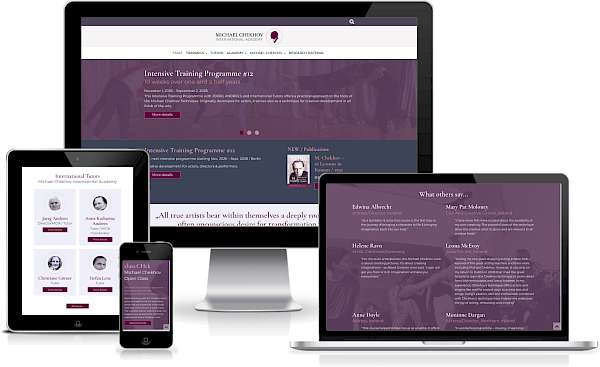 Our latest site of the week belongs to the Michael Chekhov International Academy, a Berlin-based training platform founded and led by director and acting coach Joerg Andrees.
The academy is dedicated to teaching the Michael Chekhov Technique, upholding the legacy of Russian actor Michael Chekhov (1891–1955). This is a psycho-physical acting method that emphasizes imagination, movement, and atmosphere over personal emotional memory, and it is a method that many of the greats in the industry swear by.
All true artists bear within themselves a deeply rooted and often unconscious desire for transformation.
— Michael Chekhov
The Michael Chekhov International Academy website is a straightforward, easy-to-use site with plenty of content about the academy, the technique and the man it is named after, the coaches prospective students are going to work with, and more. There are also galleries, videos, and materials offering a closer look into the teaching and methodology — and of course necessary contact details and application forms.
As for some behind the scenes details, this site was created by webdecker.de and the front-end appears to be largely custom-built, without the help of a full-blown front-end framework. There are, though some familiar libraries in use, such as jQuery and Select2. When it comes to non-core ProcessWire modules, the only ones we could spot were in-house ones, such as something that looks like a custom form management module.
Our congratulations to the client, the Michael Chekhov International Academy, for their ProcessWire powered website — and of course to Webdecker for a job well done on setting it up!
Stay tuned for our next issue
That's it for the 647th issue of ProcessWire Weekly. We'll be back with more news, updates, and content Saturday, 10th of October. As always, ProcessWire newsletter subscribers will get our updates a few days later.
Thanks for staying with us, once again. Hope you've had a great and productive week, and don't forget to check out the ProcessWire forums for more interesting topics. Until next week, happy hacking with ProcessWire!
Post a comment